

A chart of accounts is the backbone of any organized accounting system, helping businesses record, track, and analyze their financial activities with clarity. In COA accounting, this structured list categorizes every transaction, such as assets, liabilities, income, and expenses, so financial reporting remains accurate and consistent.
In this blog, we’ll explain what a chart of accounts is, how it works, why it’s important, and also show you a sample chart of accounts, plus how professional Bookkeeping Houston services can help you set it up and manage it accurately for your business.
How a Chart of Accounts Works
A chart of accounts works by organizing a company’s financial transactions into clearly defined categories, making bookkeeping and reporting simple and consistent. Each account is assigned a unique name and number and grouped under main headings such as assets, liabilities, equity, income, and expenses.
When a transaction occurs, like paying a bill or receiving a customer payment, it is recorded under the appropriate account in the chart of accounts. This system ensures every transaction is tracked in the right place, allowing accountants to easily prepare financial statements, monitor cash flow, and understand the company’s overall financial health.
Why Is a Chart of Accounts Important?
A chart of accounts is important because it provides a clear and organized structure for recording all financial transactions, ensuring accuracy and consistency in bookkeeping. It helps businesses track income, expenses, assets, and liabilities efficiently, making it easier to prepare financial statements, monitor performance, and stay compliant with accounting standards.
In the accounting field, a chart of accounts is essential because it standardizes how financial data is recorded and reported. This consistency allows accountants, auditors, and stakeholders to easily analyze records, compare financial results over time, detect errors, and make informed financial decisions with confidence.
For expert support in setting up and managing accurate records, The Madtax offers reliable bookkeeping services to help businesses stay organized, compliant, and financially confident.
Read more: How to keep your financial records organized?
Main Categories in a Chart of Accounts – COA Structure
Understanding the COA structure helps you see how a business organizes its financial information. Each category groups similar transactions together, making it easier to record data accurately and analyze financial performance. Below are the core sections you’ll find in a typical chart of accounts and the list of accounts commonly used in accounting by businesses.
1. Assets
Assets include everything a business owns or controls that helps it operate and generate income. These items have measurable value and are expected to provide future benefits to the business. Assets can be short-term (used within a year) or long-term (used for several years).
- Cash: Money in hand, bank accounts, and petty cash
- Accounts receivable: Payments owed by customers for goods or services already delivered
- Inventory: Raw materials, work-in-progress, and finished goods available for sale
- Prepaid expenses: Payments made in advance, such as rent or insurance
- Fixed assets: Long-term items like buildings, vehicles, machinery, furniture, and equipment
2. Liabilities
Liabilities include all financial obligations a business is responsible for paying. These represent money owed to lenders, suppliers, employees, or government agencies. Like assets, liabilities can be short-term or long-term.
- Accounts payable: Outstanding bills owed to suppliers or vendors
- Short-term loans: Credit lines or loans due within one year
- Long-term loans: Bank loans or mortgages payable over multiple years
- Accrued liabilities: Expenses incurred but not yet paid, such as wages, taxes, or utilities
- Deferred revenue: Payments received in advance for services or products not yet delivered
3. Equity
Equity represents the owner’s claim on the business after all liabilities are deducted from assets. It shows how much of the business truly belongs to the owner(s) or shareholders.
- Owner’s capital: Money or assets invested by the owner
- Owner’s equity: The owner’s overall financial stake in the business
- Retained earnings: Profits reinvested into the business rather than withdrawn
- Drawings or dividends: Money taken out by owners or paid to shareholders
4. Revenue (Income)
Revenue includes all money earned by the business through its normal operations. It reflects how the company generates income and grows financially.
- Sales revenue: Income from selling products
- Service income: Fees earned from providing services
- Interest income: Earnings from bank deposits or investments
- Other income: Rental income, commissions, or miscellaneous earnings
5. Expenses
Expenses include all costs required to run the business and generate revenue. Tracking expenses helps businesses control spending and measure profitability.
- Cost of goods sold (COGS): Direct costs of producing or purchasing products sold
- Operating expenses: Rent, utilities, marketing, advertising, and maintenance
- Administrative expenses: Salaries, office supplies, insurance, and professional fees
- Depreciation: The gradual reduction in value of fixed assets over time
- Interest expenses: Costs of borrowing money
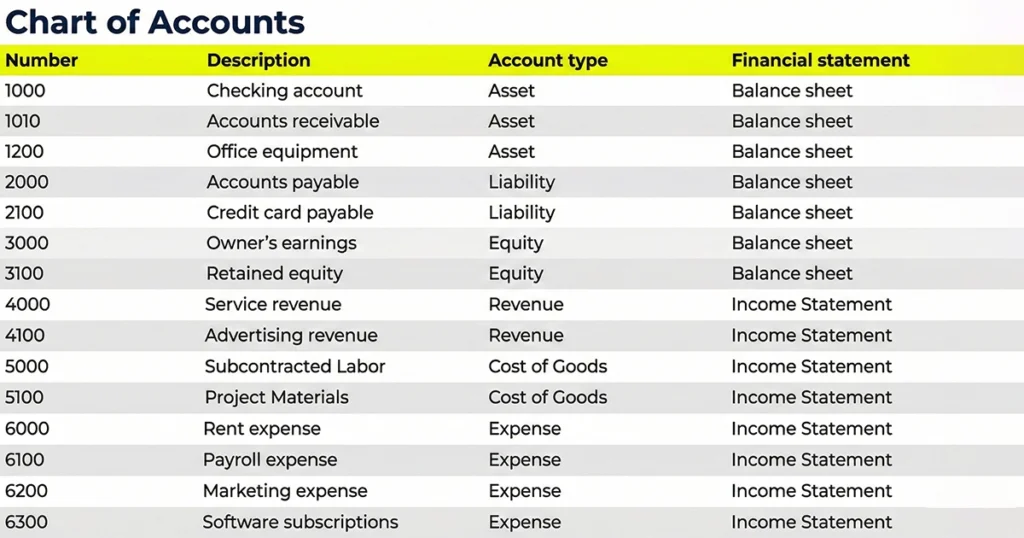
Example of Chart of Accounts
Below is a sample chart of accounts to help you understand how financial information is typically structured in real-world accounting systems. This example shows how different accounts are organized and grouped for easy tracking and reporting. Reviewing a chart of accounts like this makes it easier to see how transactions flow within a business.
Simplify Your Finances with the Right Chart of Accounts
A well-structured chart of accounts helps you organize the list of accounts in accounting, accurately track transactions, and make smarter financial decisions with confidence. If you want expert help setting up or managing your chart of accounts, The Madtax offers reliable bookkeeping services in Houston, ensuring your books stay clean, compliant, and stress-free so you can focus on growing your business.