

Cash flow management is one of the biggest challenges for small business owners in the United States.
According to financial education resources like Investopedia, many small businesses prefer simplified accounting methods because they make day-to-day bookkeeping easier and more practical for real-time decision making.
That’s where cash basis accounting becomes highly relevant for startups, freelancers, and service-based businesses.
If you are searching for a reliable bookkeeping service Houston, understanding this accounting method is essential before choosing how to manage your financial records.
What Is Cash Basis Accounting?
Cash basis accounting is a straightforward bookkeeping method where financial transactions are recorded only when cash physically enters or leaves your business. In simple terms:
- You record income only when you receive payment
- You record expenses only when you actually pay them
This makes cash basis accounting extremely easy to understand and maintain, especially for non-accountants.
Many small business owners prefer this method because it removes the complexity of tracking invoices, receivables, or payables that have not yet been settled. This is why the cash basis accounting is often associated with simplicity and real-time cash tracking.
How Cash Basis Accounting Works
Cash basis accounting records income only when cash is received and expenses only when cash is paid. Unpaid invoices and pending bills are not recorded until the actual cash transaction happens.
This keeps bookkeeping focused strictly on real money movement instead of future expectations. There is no tracking of receivables or payables in this method, which makes it different from accrual accounting and much simpler for small businesses to maintain.
Cash Basis Accounting Example
Let’s understand a practical cash basis accounting example for a small business:
Imagine you are a freelance graphic designer:
- On March 1, you send an invoice of $1,000 to a client
- On March 10, you receive the payment in your bank account
- On March 10, you record $1,000 income (not March 1)
Now assume:
- You pay $200 for software subscription on March 15
- You record the expense on March 15 when money leaves your account
This example shows how cash basis accounting only tracks actual cash movement, not pending transactions. It helps small businesses avoid confusion about unpaid invoices and pending bills.
Advantages of Cash Basis Accounting
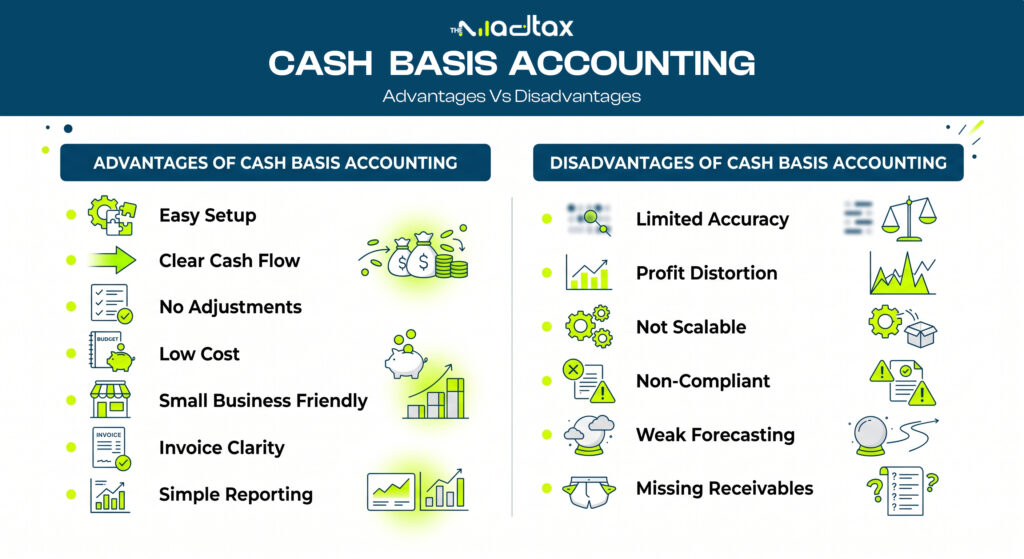
The benefits of cash basis accounting make it a preferred choice for freelancers, sole proprietors, and small service-based businesses that need a simple and practical bookkeeping system.
- Extremely easy to understand and implement: No advanced accounting knowledge is required, making it ideal for non-accountants managing day-to-day finances.
- Clear view of real cash flow: You only see money that has actually entered or left your business, which helps with immediate cash planning.
- No complex accounting adjustments: There is no need to manage accruals, deferrals, or adjusting entries at the end of the period.
- Lower bookkeeping and accounting costs: Since the system is simpler, businesses often spend less on professional accounting services.
- Ideal for small businesses and freelancers: Especially useful for service-based businesses that deal mostly in direct payments rather than credit sales.
- Reduces confusion with unpaid invoices: Income and expenses are only recorded when cash moves, avoiding complications from outstanding receivables or payables.
- Faster decision-making for small operations: Business owners can quickly understand how much cash is actually available at any time.
Because of these advantages, cash basis accounting is often recommended for businesses that are not inventory-heavy and do not require complex financial reporting.
Disadvantages of Cash Basis Accounting
Despite its simplicity, the limitations of cash basis accounting can make it unsuitable for growing or more complex businesses.
- Does not reflect true financial performance: Since it ignores unpaid invoices and pending expenses, profit may not represent the real business situation.
- Can distort profit in certain periods: Income may appear higher or lower depending on when payments are received rather than when work is done.
- Not suitable for larger or scaling businesses: As transaction volume increases, this method becomes less reliable for financial management.
- Not fully compliant with GAAP/IFRS in some cases: Many regulated businesses are required to use accrual accounting for reporting accuracy.
- Poor long-term financial forecasting: Since future receivables and payables are not recorded, planning for growth becomes difficult.
- Ignores accounts receivable and accounts payable: Outstanding customer invoices and unpaid bills are not reflected in financial statements.
- Limited financial insight for investors or lenders: External stakeholders may not get a complete picture of business health.
Cash Basis vs Accrual Accounting
The confusion around cash basis vs accrual accounting difference is common among small business owners because both methods are widely used, but they follow completely different rules for recording income and expenses.
The right choice depends on your business size, structure, and financial reporting needs.
Here’s a simple comparison:
1. Revenue Recognition:
- Cash basis: Revenue is recorded only when cash is actually received in the bank.
- Accrual accounting: Revenue is recorded when it is earned, even if payment has not been received yet.
2. Expense Recognition:
- Cash basis: Expenses are recorded only when money is paid out.
- Accrual accounting: Expenses are recorded when they are incurred, even if payment is still pending.
3. Complexity Level:
- Cash basis: Simple and easy to manage, requires minimal accounting knowledge.
- Accrual accounting: More complex because it tracks receivables, payables, and adjustments.
4. Financial Accuracy:
- Cash basis: Shows real-time cash flow but may not reflect overall business performance.
- Accrual accounting: Provides a more accurate and complete financial picture of business health.
In the United States, businesses often start with cash basis accounting, but may be required to switch to accrual accounting once they exceed certain revenue thresholds or begin carrying inventory, as per standard accounting regulations.
Who Should Use Cash Basis Accounting?
Cash basis accounting is commonly used by freelancers, independent contractors, sole proprietors, and small service-based businesses that operate with simple financial structures.
It is especially popular among startups and businesses that do not maintain inventory or deal heavily with credit transactions.
If your business mainly receives direct payments and has straightforward expenses, cash basis accounting is usually a practical and efficient choice for managing day-to-day finances.
Cash Basis Accounting and Taxes
One major advantage of cash basis accounting for tax reporting is that you only pay taxes on money you have actually received.
Key points:
- Income is taxable only when received
- Expenses are deductible when paid
- Easier tax preparation for small businesses
- Helps manage short-term cash flow for tax payments
Do You Need Cash Basis Accounting? Talk to The MadTax Experts
Cash basis accounting is one of the simplest and most practical accounting methods for small businesses.
If you need expert support, The MadTax delivers end-to-end bookkeeping, tax preparation, and financial reporting services tailored for small and growing businesses.
Their team helps ensure accurate records, better cash flow tracking, and compliance-ready financials, making it easier to scale beyond basic cash basis accounting. Visit their website today for professional bookkeeping support.